
- Audience
- Water microbiology laboratories, utilities, QA/QC teams and distributors
- Region
- Global / EU
- Level
- Technical validation
- Reading time
- 12 min
Related topics: ENUMERA Coli100, AquaColi, E. coli, Total coliforms, ISO 9308-2, MPN, Chromogenic medium
Executive summary
- The paper presents ENUMERA Coli100, using the AquaColi chromogenic medium for E. coli and total coliform enumeration in 100 mL samples.
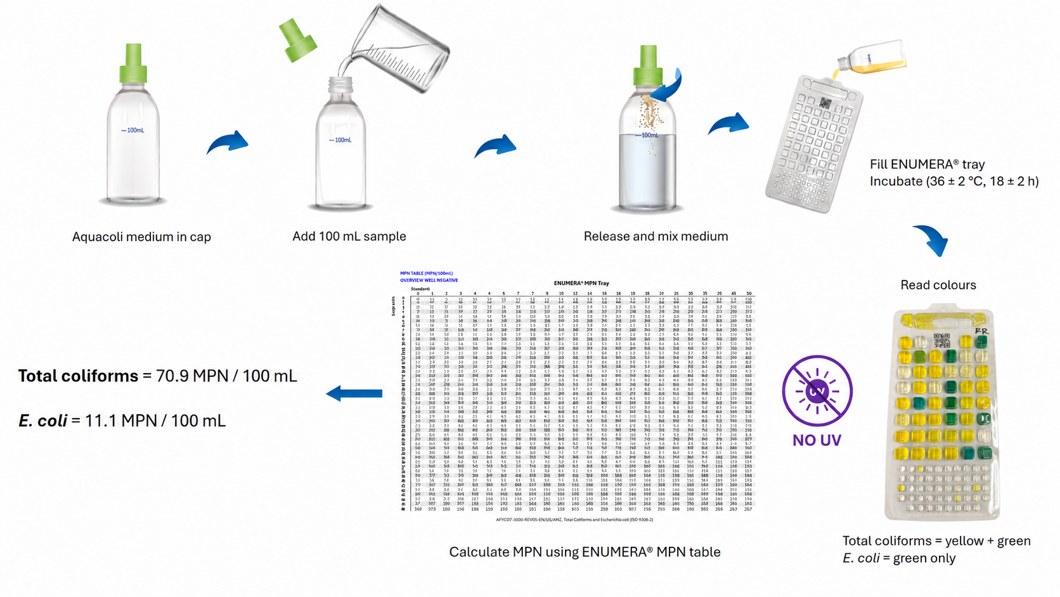
- The method replaces UV fluorescence for E. coli reading with a visible green chromogenic reaction under ambient light.
- The reagent is integrated into a closed cap format that releases dehydrated medium into the sample with fewer open handling steps.
- Validation compared the method with ISO 9308-2 using 120 samples across drinking water, surface water, wastewater, reclaimed water and seawater.
- Results supported analytical comparability with the reference method, including 100% sensitivity, strong specificity and selectivity, linearity, satisfactory LOD/LOQ and coherent quantitative agreement.
What was validated
The study evaluated a complete MPN workflow: medium, bottle, reagent-in-cap handling, tray geometry, incubation and statistical interpretation. Total coliforms are indicated by yellow wells, while E. coli is indicated by green wells. The reading can be performed under ordinary visible light.
| Validation area | What the manuscript evaluates | Why it matters |
|---|---|---|
| Matrix coverage | Drinking, surface, wastewater, reclaimed water and seawater | Supports use across routine water microbiology contexts |
| Method comparison | ISO 9308-2 reference workflow versus ENUMERA Coli100 | Shows practical equivalence for enumeration decisions |
| Selectivity and specificity | Coliform, E. coli and non-coliform strain panels | Checks expected biochemical response |
| MPN statistics | Tray volumes and proprietary MPN table | Keeps the physical tray and calculation model aligned |
| Operational workflow | Visible chromogenic reading and closed cap handling | Reduces UV equipment dependency and sample manipulation |
Operational relevance
The manuscript is especially relevant for laboratories that want an MPN workflow aligned with ISO 9308-2 principles without UV interpretation. It keeps the biochemical detection targets used in established coliform and E. coli methods, but moves the readout to a visible chromogenic reaction and simplifies reagent handling.
Downloads
Implementation checklist
- ✓ Confirm the sample matrix and intended decision context.
- ✓ Define whether the workflow is for screening, routine enumeration, validation or internal verification.
- ✓ Review ISO 9308-2 alignment, incubation conditions, tray interpretation and MPN table use.
- ✓ Train analysts on yellow and green well interpretation under visible light.
- ✓ Keep batch, operator, sample point, result and review history traceable in the quality system.
Related AquaVerify products
Recommended next step
FAQ
Is this a replacement for laboratory verification?
No. The paper provides validation evidence for the method comparison. Each laboratory still needs to follow its accreditation, quality-system and competent-authority requirements before routine implementation.
What is the main operational difference versus UV-based MPN methods?
The E. coli response is read as a visible green chromogenic reaction, avoiding UV illumination during result interpretation.
Which matrices were included?
The validation included drinking water, surface water, wastewater, reclaimed water and seawater.
References
- Full manuscript: AquaColi / ENUMERA Coli100 validation against ISO 9308-2.
- Supplementary material: ENUMERA MPN table.
- ISO 9308-2: Water quality - Enumeration of Escherichia coli and coliform bacteria - Part 2: Most probable number method.